In preparing for tomorrow's (ed: well, technically today's) lecture on 80's metal and 90's alternative, I realized that in my last lecture, I unwittingly passed an important milestone.
On Tuesday I played my class a snippet of Michael Jackson's "Beat It", just to point out that Jackson's complex fusion of many musical genres included heavy metal, in the form of a guitar solo by Eddie Van Halen. Ladies and gentlemen, "Beat It" was the very first pop song I can remember. I don't believe I heard it when it first came out, as Thriller came out when I was only three. But at a very early age, probably about five, I distinctly remember hanging out with my best friend in his kitchen, and he had a cassette tape of "Beat It." We both thought it was pretty cool, and I memorized the words as best as I could. Even then, in my pre-musicological childhood, I could sense that illicit danger early Michael Jackson communicated so effectively and creepily.
As we now move further into music with which I have very deep personal connections from my youth--particularly Nirvana and Metallica--I admit I feel a little trepidation. Am I going to do this music justice? Am I going to be critical enough? Am I going to have any insights, or am I just going to sit up there and be Mr. Fanboy? I'm bringing in my guitar, mostly to demonstrate power chords and two-handed fret-tapping for the 80's metal, but I know I am not going to resist playing some Nirvana. After all, I learned how to play guitar by playing along with Nevermind for hours at a time, and I can still more or less play my way through the entire Nirvana catalogue, from Bleach to In Utero. (Unplugged too, which although clearly sub-par did introduce me to Bowie and Leadbelly.) I hope it works--I've found that some of my most effective lectures have been on music with which I very clearly did not identify, such as early hip-hop.
I considered including in my slide show a picture of me in full grunge regalia, with shoulder-length hair dyed black, but I think that might cause them to lose all respect for me.
Thursday, July 27, 2006


Tuesday, July 25, 2006
Mooooo
I promised myself I wouldn't blog about the heat. Yes, it's been real hot in Los Angeles for the past week or so. Horribly hot. Humid, and swampy, and life- and cow-threateningly hot. Blackouts have been threatened, the power grid is melting. The end times might be near. If cows are dying, what next?
But every single LA-based blog has been complaining about the heat. Even visiting bloggers. So I promised myself I wouldn't blog about the heat, and stick to trenchant comments about teaching, and punk rock.
But you know, it's really, really hot.
But every single LA-based blog has been complaining about the heat. Even visiting bloggers. So I promised myself I wouldn't blog about the heat, and stick to trenchant comments about teaching, and punk rock.
But you know, it's really, really hot.
Sunday, July 23, 2006
Dio Mio
Letter from David Tudor to M.C. Richards, November 1954
I love archival research! Even though I am probably violating all sorts of copyright rules by posting this little extract.
...John [Cage] does very well in Paris. One talks incessantly about the situation internationelle des arts an intellectual tour of what goes on in the world of art. How can one have conversation without movement of the wind? It's dirtying up the street with words. Sometimes I think I will retch if I hear another word about chance or control or "very interesting" or "very importante parce que" closing in quickly to make a judgment. And John is just as bad as the rest, everything to be rivant but this seems to function like masturbation. So that's really how I feel about it being "clear," and then claiming that this same clarity is "mysterious"--really, don't you say so, let's go somewhere else, where there's no need for clarity or just no-need-period. See you all in the funny papers. One might say "shit" but that's a European word these days. If I go any farther with this it might turn into a polemic--dio mio!...
I love archival research! Even though I am probably violating all sorts of copyright rules by posting this little extract.
Saturday, July 22, 2006
Blank Generation
Those who know me know that I am rather passionate on the subject of Patti Smith. If memory serves, one of my first posts on this here blog thing was about seeing her in concert. (Incidentally, that same concert was recorded and released as part of the special reissue of Horses last year.) There are a lot of things that draw me towards Patti: her politics, her sex appeal, her voice, her moral authority, her guitarist. She means a lot to me also as a passion that Mary and I have shared together for many years. And as a historian, I appreciate the crucial role she played in the early stages of the NYC punk scene of the mid-seventies.
One of my favorite things about teaching is that when I am lecturing, everything I say automatically becomes true for all these undergrads. Yes, I wish they were thinking more critically, and yes, I wish that more learning here took place in smaller situations that encouraged discussion and said critical thinking, rather than me standing on a stage in front of sixty people. And I try hard not to teach music history as some sort of coherent, linear, bedtime story. We responsible teachers focus on problems of historiography, the question of "authenticity" in popular music, the ways in which music shapes our social identities.
But sometimes story-telling is necessary, and when it is, I love the fact that I get to be the one telling the story. I love telling everyone that no, neither the Sex Pistols nor the Ramones invented punk rock. It wasn't a group of obnoxious boys playing cynical three-chord rock loud and fast. It was, rather, a hallucinatory poet who invented punk rock, taking her fashion cues from nineteenth-century symbolist poets, her lyrics from the NYC spoken word scene, and the music--assisted by the indomitable Lenny Kaye--from the angry garage rock of the midwest. My students grew up thinking that punk rock is like Green Day, or--god forbid--Blink 182. The slightly more astute might know punk rock from its time in the wilderness, when it existed only in small regional underground scenes around the country. Nothing wrong with that music, but there is nothing better than playing for my students the actual music of CBGB's in 1975: Patti, Television, the Heartbreakers, Blondie, and yes, even the Ramones. I'm not sure they quite get how powerful this stuff is, how subversive it still sounds.
But I hope that just hearing the music expands their ears a little bit, and hopefully their brains a bit too. It's naive, I realize, to think that just hearing this music will change the students in some important way. That is hopelessly romantic, almost anti-intellectual. But even we pomo academics hope for such mystical accomplisments occasionally.
One of my favorite things about teaching is that when I am lecturing, everything I say automatically becomes true for all these undergrads. Yes, I wish they were thinking more critically, and yes, I wish that more learning here took place in smaller situations that encouraged discussion and said critical thinking, rather than me standing on a stage in front of sixty people. And I try hard not to teach music history as some sort of coherent, linear, bedtime story. We responsible teachers focus on problems of historiography, the question of "authenticity" in popular music, the ways in which music shapes our social identities.
But sometimes story-telling is necessary, and when it is, I love the fact that I get to be the one telling the story. I love telling everyone that no, neither the Sex Pistols nor the Ramones invented punk rock. It wasn't a group of obnoxious boys playing cynical three-chord rock loud and fast. It was, rather, a hallucinatory poet who invented punk rock, taking her fashion cues from nineteenth-century symbolist poets, her lyrics from the NYC spoken word scene, and the music--assisted by the indomitable Lenny Kaye--from the angry garage rock of the midwest. My students grew up thinking that punk rock is like Green Day, or--god forbid--Blink 182. The slightly more astute might know punk rock from its time in the wilderness, when it existed only in small regional underground scenes around the country. Nothing wrong with that music, but there is nothing better than playing for my students the actual music of CBGB's in 1975: Patti, Television, the Heartbreakers, Blondie, and yes, even the Ramones. I'm not sure they quite get how powerful this stuff is, how subversive it still sounds.
But I hope that just hearing the music expands their ears a little bit, and hopefully their brains a bit too. It's naive, I realize, to think that just hearing this music will change the students in some important way. That is hopelessly romantic, almost anti-intellectual. But even we pomo academics hope for such mystical accomplisments occasionally.
Wednesday, July 19, 2006
Democracy Exercised
My god, what an unpleasant two days of jury duty. I shouldn't complain too much--here it is Tuesday, and I am all done. Considering some other jurors were assigned to a thirty day civil trial, I should count myself lucky.
But it was definitely a big hassle. I showed up at a downtown LA courthouse at 7:30 am, ready for duty. Sat around for a bit, and it quickly became clear that there weren't many trials going on, which seemed like a good sign. A bunch of jurors were reassigned to a courthouse in Burbank, where there was a more pressing need for warm bodies, and I was thankful not to be one of them! But then, of course, at 11:00 am, when I had visions of being sent home at lunch time, the last twenty of us there were reassigned to a superior court in Inglewood.
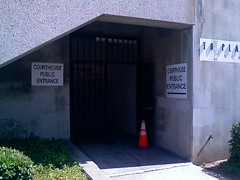
What a pain! Luckily I had driven, I can't imagine what bus people did. So I show up in Inglewood at 1:30. Now, the downtown courthouse was nothing fancy, but it was well-appointed, and even though downtown LA is not exactly thriving, it nevertheless has plenty of restaurants and attractions. Inglewood, not so much. The courthouse was a parody of poor modernist urban planning: the classic featureless box looming imperialistically over the landscape, with a "plaza" in front that was not only barren and soul-less, but was elevated a story above street level. The picture to the right is the entrance to the plaza. Nothing like welcoming the public to this pinnacle of democracy!
Anyways, the trial. The first day was spent waiting around doing nothing. Luckily, part of my job is reading books for a living, and I was able to read an entire book I needed to get through for teaching next week--Jeff Chang's excellent history of hip-hop. Finally at 4:30pm, all 75 of us in the prospective juror pool were called into the court room, where the judge introduced herself, the prosecutor, and the defendants, and read the charges. It is hard to figure out exactly what happened simply from the list of charges, but involved robbery, intimidation, guns, and at least one person shot. Juicy stuff. But the real juicy part was that the defendants were representing themselves, which explained why everything had been taking so long.
One thing that amazed me was the initial juror screening. The judge asked if there was anyone who had a bias or prejudice against the defendants--two black men. Now, I wanted to get out of jury duty as much as the next, but at least a dozen jurors were willing to stand up in court and claim that they were racist to get out of the trial!
Actual jury selection didn't get started before quitting time, so we had to come back at 8:30 am the next morning. We were all dutifully there, but once again, the day dragged on with no progress or information. At 9:30 we were told we weren't needed until 11:00 am, and then at 11, we were told to come back at 1:30pm. Finally, we were called into the court room, and selection was about to start. First, though, the judge asked if any of us had discussed the trial with one another. A few people raised their hands. Then she asked if any of us had discussed with one another the issue of the defendants representing themselves. Nearly thirty people raised their hands at that moment. So the judge sighed, asked the rest of us to exit, and began interviewing the troublesome jurors one by one. She must have made it through about ten of them when she called us all back in, and informed us that the juror pool was irrevocably tainted, and she was going to start over with a new group.
Gotta say, I was thrilled! The trial was going to be held in the afternoons, so I actually could have taught and served at the same time. But two days of sitting around waiting and waiting, in a poorly-air-conditioned room, in the middle of a burnt-out section of Inglewood, was about all I could take. So, democracy served, of a sort, and back to normal life!
But it was definitely a big hassle. I showed up at a downtown LA courthouse at 7:30 am, ready for duty. Sat around for a bit, and it quickly became clear that there weren't many trials going on, which seemed like a good sign. A bunch of jurors were reassigned to a courthouse in Burbank, where there was a more pressing need for warm bodies, and I was thankful not to be one of them! But then, of course, at 11:00 am, when I had visions of being sent home at lunch time, the last twenty of us there were reassigned to a superior court in Inglewood.
Anyways, the trial. The first day was spent waiting around doing nothing. Luckily, part of my job is reading books for a living, and I was able to read an entire book I needed to get through for teaching next week--Jeff Chang's excellent history of hip-hop. Finally at 4:30pm, all 75 of us in the prospective juror pool were called into the court room, where the judge introduced herself, the prosecutor, and the defendants, and read the charges. It is hard to figure out exactly what happened simply from the list of charges, but involved robbery, intimidation, guns, and at least one person shot. Juicy stuff. But the real juicy part was that the defendants were representing themselves, which explained why everything had been taking so long.
One thing that amazed me was the initial juror screening. The judge asked if there was anyone who had a bias or prejudice against the defendants--two black men. Now, I wanted to get out of jury duty as much as the next, but at least a dozen jurors were willing to stand up in court and claim that they were racist to get out of the trial!
Actual jury selection didn't get started before quitting time, so we had to come back at 8:30 am the next morning. We were all dutifully there, but once again, the day dragged on with no progress or information. At 9:30 we were told we weren't needed until 11:00 am, and then at 11, we were told to come back at 1:30pm. Finally, we were called into the court room, and selection was about to start. First, though, the judge asked if any of us had discussed the trial with one another. A few people raised their hands. Then she asked if any of us had discussed with one another the issue of the defendants representing themselves. Nearly thirty people raised their hands at that moment. So the judge sighed, asked the rest of us to exit, and began interviewing the troublesome jurors one by one. She must have made it through about ten of them when she called us all back in, and informed us that the juror pool was irrevocably tainted, and she was going to start over with a new group.
Gotta say, I was thrilled! The trial was going to be held in the afternoons, so I actually could have taught and served at the same time. But two days of sitting around waiting and waiting, in a poorly-air-conditioned room, in the middle of a burnt-out section of Inglewood, was about all I could take. So, democracy served, of a sort, and back to normal life!
Monday, July 17, 2006
Civic Duty
Why am I awake at five o'clock in the morning? Because I have to report for jury duty, that's why. At 7:30 am, in downtown Los Angeles.
Argh.
Argh.
Sunday, July 16, 2006
Farewell, Adele
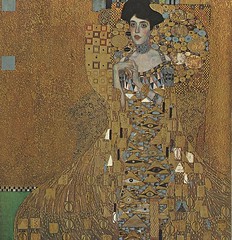
Although glad to see them in a museum open for public viewing, it saddens me to see these paintings leave Los Angeles. LACMA and other area museums attempted to put together a bid for them, but LACMA is not a wealthy institution, and it never came together. It is too bad, because having the painting here would have been a tangible link to one of the most important stories of Los Angeles: the emmigration of many important European artists to the area in the 1930s and 1940s: Igor Stravinsky, Arnold Schoenberg, Thomas Mann, Rudolf Schindler, Aldous Huxley...many others I can't think of at the moment. The Bloch-Bauers, like so many other Jewish families, ended up in Los Angles having fled Hitler. Ironically, their lawyer in the lawsuit to regain the paintings was a grandson of Schoenberg.

But I wish there was more. In so many cities, you have layers of history that you can feel as you walk the streets, or talk to people. You just don't have that feeling here. I know that this isn't how Los Angeles works, and that as the great postmodern city, I need to appreciate it on postmodern terms. But as I watch buildings go up and down, and people move in and out, I can't help wishing that more people and things would leave something behind.
Saturday, July 15, 2006
Kiss Lieberman Goodbye
Today's New York Times has an article about the bruising primary fight around Senator Lieberman. It is a very frustrating piece, typical of the Times. Poor Lieberman, he's trying to be all collegial and nice and non-partisan, and those flame-breathing anti-war Democrats are out to get him. The unspoken politics of the Times is that having political beliefs, either left or right, is wrong. The only correct way to do politics is in the "middle", where there are no ideologies or beliefs involved. Please! Nothing frustrates me more than moderates who claim to have no ideology. Of course they have an ideology. I don't know anyone more ideological than Joseph Lieberman. I find it profoundly insulting that people such as myself who are not afraid to speak their political beliefs out loud get labeled extremist, and those who keep them secret--or "moderate", as they say--are given some sort of moral legitimacy.
I guess I shouldn't be surprised that the status quo newspaper supports the status quo.
One of the more frustrating things about this article is the claim that this is simply a knee-jerk reaction by anti-war Democrats. The fight against Joseph Lieberman goes back a long way. When I was living in Connecticut, I was often pretty heavily involved in state Democratic Party politics, from driving Susan Bysiewicz to a fundraising cocktail party in her first run for statewide office, to participating in a secretly-organized slander of now-former Congressman Sam Gejdensen's Republican opponent--after that little adventure, I was literally advised that I should stay inside for a few days and not answer the phone, lest the media find me. Not one of my prouder moments.
Anyways, this is just to say that I've known people in the Connecticut Democratic Party for quite awhile. And I can tell you, even way back in 1998, when the Iraq War was still just a twinkle in the Bush family eyes, the grassroots of the state party hated--hated--Joseph Lieberman. And it wasn't a matter of ideology, or even any specific political platform. It was that he was considered a Machiavellian, power hungry jerk who was personally unpleasant to everyone in the party, and had made his career by running against fellow Democrats. Lieberman got his start doing just what Lamont is doing now--by attacking the Democratic Party from the inside. And now finally it's caught up to him.
I guess I shouldn't be surprised that the status quo newspaper supports the status quo.
One of the more frustrating things about this article is the claim that this is simply a knee-jerk reaction by anti-war Democrats. The fight against Joseph Lieberman goes back a long way. When I was living in Connecticut, I was often pretty heavily involved in state Democratic Party politics, from driving Susan Bysiewicz to a fundraising cocktail party in her first run for statewide office, to participating in a secretly-organized slander of now-former Congressman Sam Gejdensen's Republican opponent--after that little adventure, I was literally advised that I should stay inside for a few days and not answer the phone, lest the media find me. Not one of my prouder moments.
Anyways, this is just to say that I've known people in the Connecticut Democratic Party for quite awhile. And I can tell you, even way back in 1998, when the Iraq War was still just a twinkle in the Bush family eyes, the grassroots of the state party hated--hated--Joseph Lieberman. And it wasn't a matter of ideology, or even any specific political platform. It was that he was considered a Machiavellian, power hungry jerk who was personally unpleasant to everyone in the party, and had made his career by running against fellow Democrats. Lieberman got his start doing just what Lamont is doing now--by attacking the Democratic Party from the inside. And now finally it's caught up to him.
Tuesday, July 11, 2006
I Can't Get No
Man, this edumacating thing takes it out of me. I'm quickly settling into a routine with my lectures: first two hours are fine, but as I enter the home stretch of the third hour, I start to give out. My throat begins to ache, my legs feel like they are glued to the floor, and I forgo class discussion and painstaking analysis for stuttering quickie points on, say, how Keith Richard's guitar lick from "Satisfaction" isn't actually a blues riff, but an attempt to imitate the horn section of a Motown number. Write that down, kids.
Still, all and all, I'm pretty pleased. We're getting through the material, people occasionally laugh at my jokes. And I think this experience is really just about learning techniques for endurance: the importance of having water to drink, the importance of standing up straight and wearing comfortable shoes, the importance of good air conditioning.
Tomorrow I take a break from teaching for some honest to goodness dissertation research. The Getty Research Institute, located in a building on the grounds of the Getty Museum, has a wonderful library that holds the papers of several figures important to me: M.C. Richards, Allan Kaprow, Dick Higgins, and especially David Tudor. I've worked some with the Tudor papers already, especially his scores, but now I'm going to dive into his correspondence, and that of Richards. This is no substitute for getting to the Cage papers in Chicago, but it is a good start, and as far as I can tell, I don't think many Cage scholars have looked through the Richards papers. I have an all-day appointment tomorrow, so we'll see what I dig up!
Still, all and all, I'm pretty pleased. We're getting through the material, people occasionally laugh at my jokes. And I think this experience is really just about learning techniques for endurance: the importance of having water to drink, the importance of standing up straight and wearing comfortable shoes, the importance of good air conditioning.
Tomorrow I take a break from teaching for some honest to goodness dissertation research. The Getty Research Institute, located in a building on the grounds of the Getty Museum, has a wonderful library that holds the papers of several figures important to me: M.C. Richards, Allan Kaprow, Dick Higgins, and especially David Tudor. I've worked some with the Tudor papers already, especially his scores, but now I'm going to dive into his correspondence, and that of Richards. This is no substitute for getting to the Cage papers in Chicago, but it is a good start, and as far as I can tell, I don't think many Cage scholars have looked through the Richards papers. I have an all-day appointment tomorrow, so we'll see what I dig up!
Monday, July 10, 2006
La tragèdie bleue
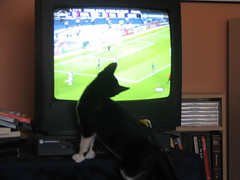
And then...Zidane goes and ruins it all. Totally crushed me. France played the better game, but after that head-butt, Italy deserved to win. And I'm glad they did.
Pablo, I suspect, was rooting for the Italians from the beginning.
Thursday, July 06, 2006
Thursday Cat Blogging
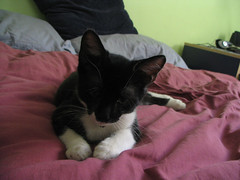
P.S. How do you know you've really advanced to doctoral candidacy? When a $65 "Doctoral Candidate" fee shows up on your student account, that's how.
Wednesday, July 05, 2006
Theory, Music
Critic, scholar, and composer Kyle Gann has a wonderful post on his blog about teaching and learnin music theory. Much of it it really rings true for me, and not just the quip that Schenkerian analysis belongs in the religion department. It's a long post, but worth the read!
London Photos
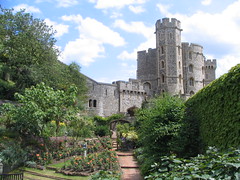
Enjoy!
Monday, July 03, 2006
Dusty in Memphis
Friday was payday, so, as is my usual custom, I walked down to the Tower Records on the Sunset Strip to pick myself up a treat. Last month was Peggy Lee's Black Coffee, this month's, following in the icy blonde theme, was Dusty Springfield's Dusty in Memphis.

I discovered Dusty for the first time when I was TAing a course on gay and lesbian popular music. I had heard her music before, of course, but just as part of that strange ahistorical soup of music that gets played on oldies stations. Her music is so stylistically diverse, I certainly never thought that "I Only Want to Be With You" and "Son of a Preacher Man" were by the same person. And I certainly never would have that this music was by an English lesbian of Irish descent!
Side note: A friend of mine likes to joke that Dusty's "Wishin' and Hopin'" is her revenge on heterosexuality. Just consider the lyrics:
This is Dusty's advice to some poor little straight girl? If you like a guy, don't just hope he likes you. Instead, have sex with him--oh, I'm sorry, "hold him and kiss him and squeeze him"--do everything he tells you to, and then maybe he will like you. Nice advice, Dusty.
Anyways, Dusty in Memphis. What a great album. She recorded it in 1969, at a time when her career was sort of in the doldrums. So she made a deal to go record an album with Atlantic Records at their "soul" studio in Memphis, using many of the same studio musicians who had played on Aretha Franklin's breakthrough debut album. Although like Aretha, she recorded her actual vocals back at a fancier studio in New York City. "Son of a Preacher Man" is obviously the stand-out track on this album, but the entire thing really holds together well. Dusty idolized Aretha's singing style, but really, she does things her own way. What I find most attractive is her sense of restraint. Unlike every single wanna-be soul singer on American Idol, she knows that the key to singing soul--especially if it is not the idiom one has grown up with--is not to simply go for vocal pyrotechnics. If you go back and listen to "Son of a Preacher Man" now, you'll hear that it is actually remarkably restrained. She always seems to be holding back something, never quite giving all of herself up to the music. It's a lovely sound, with a hint of menace to it.
So, musicological advice of the week, go buy and listen to this album. Rhino has a great reissue that has a bunch of unreleased tracks from the period.

Side note: A friend of mine likes to joke that Dusty's "Wishin' and Hopin'" is her revenge on heterosexuality. Just consider the lyrics:
Wishin' and hopin' and thinkin' and prayin'
Plannin' and dreaming each night of his charms
That won't get you into his arms
So if you're lookin' to find love you can share
All you gotta do is
Hold him and kiss him and love him
And show him that you care
Show him that you care just for him
And do the things he likes to do
Wear your hair just for him, 'cause
You won't get him
Thinkin' and a-prayin'
Wishin' and a-hopin'
Just wishin' and hopin' and thinkin' and prayin'
Plannin' and dreamin' his kiss is the start
That won't get you into his heart
So if you're thinkin' heartbreak
True love is
All you gotta do is
Hold him and kiss him and squeeze him and love him
Yeah, just do it and after you do, you will be his
This is Dusty's advice to some poor little straight girl? If you like a guy, don't just hope he likes you. Instead, have sex with him--oh, I'm sorry, "hold him and kiss him and squeeze him"--do everything he tells you to, and then maybe he will like you. Nice advice, Dusty.
Anyways, Dusty in Memphis. What a great album. She recorded it in 1969, at a time when her career was sort of in the doldrums. So she made a deal to go record an album with Atlantic Records at their "soul" studio in Memphis, using many of the same studio musicians who had played on Aretha Franklin's breakthrough debut album. Although like Aretha, she recorded her actual vocals back at a fancier studio in New York City. "Son of a Preacher Man" is obviously the stand-out track on this album, but the entire thing really holds together well. Dusty idolized Aretha's singing style, but really, she does things her own way. What I find most attractive is her sense of restraint. Unlike every single wanna-be soul singer on American Idol, she knows that the key to singing soul--especially if it is not the idiom one has grown up with--is not to simply go for vocal pyrotechnics. If you go back and listen to "Son of a Preacher Man" now, you'll hear that it is actually remarkably restrained. She always seems to be holding back something, never quite giving all of herself up to the music. It's a lovely sound, with a hint of menace to it.
So, musicological advice of the week, go buy and listen to this album. Rhino has a great reissue that has a bunch of unreleased tracks from the period.
Friday, June 30, 2006
Wednesday, June 28, 2006
Inauspicity
Folks, you are not going to be believe what I did yesterday. I hesitated to even blog about it, because this is exactly the sort of story one does not want a future employer reading. But here we go: you know how this summer I am teaching my own course for the first time, an introductory lecture course on popular music to about sixty undergraduates? And that I have been very excited about teaching this class, and getting to pretend to be a "real" professor type, and write my own syllabus, teach my own material, and all that?
Well, yesterday I almost missed the very first day of class.
Somehow, all quarter, I have had written down in my calendar that the summer quarter begins on June 29. Thus, I had arranged to get back from England on the 26th, giving me enough time to get over jet lag and make last-minute preparations. Well, I got in from the UK at 10pm Monday night, horribly jet-lagged, and suffering from a bad cold I had picked up my last day in London. Just before I collapse in bed, I see an email from my colleague and TA extraordinaire, K--, asking if I need anything before tomorrow. I cheerfully write back, "of course not, we don't teach until Thursday!" Then I go to sleep.
At 3am, my jet-lagged body wakes up, and I check my email. There is a note from K-- which says, in effect, "okay, but you know that the registrar has us listed as starting tomorrow?" Sure enough, she's right. I am due to be teaching that morning, at 9:30 am.
Now mind you, I have completed my syllabus, and had done a fair amount of prep for my first lecture. But I now I have an extra class I didn't plan for, which means re-shuffling my whole syllabus around. And there is still quite a few loose ends and details to be cleared up for my lecture. So at about 3:30 am, I get to work. By 9:30am, I am indeed ready to go, but let me tell you, it was one of the worst lecture experiences of my life. I had slept about three hours in the last 32 hours, had a bad cold, and was not as prepared as I wanted to be. My voice kept giving out, I was feverishly sweating, I occasionally had to steady myself on the piano, and I kept losing my train of thought mid-sentence.
Somehow made it through though. It's a good learning experience, and as several people have pointed out to me, teaching conditions are rarely any more adverse than this. I just hope I can win back my class on Thursday!
This post will self-destruct as soon as I am on the job market.
Well, yesterday I almost missed the very first day of class.
Somehow, all quarter, I have had written down in my calendar that the summer quarter begins on June 29. Thus, I had arranged to get back from England on the 26th, giving me enough time to get over jet lag and make last-minute preparations. Well, I got in from the UK at 10pm Monday night, horribly jet-lagged, and suffering from a bad cold I had picked up my last day in London. Just before I collapse in bed, I see an email from my colleague and TA extraordinaire, K--, asking if I need anything before tomorrow. I cheerfully write back, "of course not, we don't teach until Thursday!" Then I go to sleep.
At 3am, my jet-lagged body wakes up, and I check my email. There is a note from K-- which says, in effect, "okay, but you know that the registrar has us listed as starting tomorrow?" Sure enough, she's right. I am due to be teaching that morning, at 9:30 am.
Now mind you, I have completed my syllabus, and had done a fair amount of prep for my first lecture. But I now I have an extra class I didn't plan for, which means re-shuffling my whole syllabus around. And there is still quite a few loose ends and details to be cleared up for my lecture. So at about 3:30 am, I get to work. By 9:30am, I am indeed ready to go, but let me tell you, it was one of the worst lecture experiences of my life. I had slept about three hours in the last 32 hours, had a bad cold, and was not as prepared as I wanted to be. My voice kept giving out, I was feverishly sweating, I occasionally had to steady myself on the piano, and I kept losing my train of thought mid-sentence.
Somehow made it through though. It's a good learning experience, and as several people have pointed out to me, teaching conditions are rarely any more adverse than this. I just hope I can win back my class on Thursday!
This post will self-destruct as soon as I am on the job market.
Monday, June 26, 2006
Monday, June 19, 2006
Historicity
There a number of towns in England which have been kept meticulously "historic." I'm thinking, for example, of Stratford-upon-Avon, Windsor, Bourton-on-the-Water, and so on. There is a subtle formula that creates these towns: they can't be too large, because then the pressures of industrialization, need for housing, public transportation, etc., tend to have overriden any desire to maintain older buildings with consistency. But they also can't be too small, because it does take money to maintain all of that history. And of course, the most important part of the formula is tourism, which provides the money and energy to create systematic plans to retain the historic character of entire districts, rather than just individual buildings.
The thing is, of course, that all of these "historic" towns end up kind of looking the same. Stratford-upon-Avon looks a lot like Bourton-on-the-Water, which looks a lot like Windsor, which looks a lot like St. Albans. These towns are all in drastically different areas, and have very different histories, but they really do all blend together. I think it is because people, especially tourists but also the historic preservation industry, privilege certain historical architectural styles over others. We love timbered construction (what we call "Tudor" style in the U.S.), low ceilings, thatched roofs, wattle and daub walls, and so on. And so certain buildings get preserved, but not others--in the Cotswolds, for instance, there are lots of stories of people "renovating" Jacobean and Georgian structures by adding thatched roofs!
Anyways, I don't have any larger point here. Yesterday, Mary, Laura and I spent a very pleasant afternoon in St. Albans, which is only about ten minutes away from Barnet. It was the home of a famous abbey once upon a time, although post-Henry VIII all that remains now is a large gate. But there is also a funny little cathedral, and a really nice park that has some great Roman ruins. We had a leisurely lunch at Ye Olde Fighting Cocks, a very old pub that was once the pigeon house for the abbey. All day I'd had a hankering for British food, and I was pleased to be able get a Sunday roast with Yorkshire pudding. Delicious!
The thing is, of course, that all of these "historic" towns end up kind of looking the same. Stratford-upon-Avon looks a lot like Bourton-on-the-Water, which looks a lot like Windsor, which looks a lot like St. Albans. These towns are all in drastically different areas, and have very different histories, but they really do all blend together. I think it is because people, especially tourists but also the historic preservation industry, privilege certain historical architectural styles over others. We love timbered construction (what we call "Tudor" style in the U.S.), low ceilings, thatched roofs, wattle and daub walls, and so on. And so certain buildings get preserved, but not others--in the Cotswolds, for instance, there are lots of stories of people "renovating" Jacobean and Georgian structures by adding thatched roofs!
Anyways, I don't have any larger point here. Yesterday, Mary, Laura and I spent a very pleasant afternoon in St. Albans, which is only about ten minutes away from Barnet. It was the home of a famous abbey once upon a time, although post-Henry VIII all that remains now is a large gate. But there is also a funny little cathedral, and a really nice park that has some great Roman ruins. We had a leisurely lunch at Ye Olde Fighting Cocks, a very old pub that was once the pigeon house for the abbey. All day I'd had a hankering for British food, and I was pleased to be able get a Sunday roast with Yorkshire pudding. Delicious!


Saturday, June 17, 2006
St. George on a Stick
I arrived safely in London yesterday after a fairly hassle-free flight. Air New Zealand was nice enough. About the same level of service as BA, although they did have a nicer in-flight entertainment system. (As you might expect, the entire Lord of the Rings cycle was available fore viewing). On the way back from Heathrow we stopped for lunch at Wagamama (I would give anything for them to expand to the U.S.), and then had a pleasant evening relaxing around the house and the local pub.
Barnet is still more or less the same as ever. The one funny thing about London at the moment is that every pub, house, apartment, and car is flying the English flag at the moment--not the Union Jack, but the red and white cross that is specific to just England, rather than Great Britain. It is theoretically in celebration of the World Cup (not that England has much to celebrate at the moment), but it is a weird phenomenon, because flying the English flag has for a long time been associated with the BNP and various right-wing fascist movements in the U.K. There is a lot of talk in the papers of English citizens "reappropriating" the flag back from racist use, but I have to say, I'm not sure I like it. True, the flag now has less racist connotations than it once did. But at the same time, I have yet to see a non-white Brit flying the flag from his or her car, and I bet they are supporting the World Cup as much as everyone else. It's like the Confederate flag in the states--you can say it means whatever you want, but as a matter of how people receive it, there will always be resonances beyond your control. And even if the flag was purely harmless, flying flags from your car is such an....American way to celebrate things.
I've decided that Brazil is going to be my team for the World Cup this year. Both the U.S. and the U.K. are unworthy of my support, and Brazil has Kaka, who is pretty hot.
Barnet is still more or less the same as ever. The one funny thing about London at the moment is that every pub, house, apartment, and car is flying the English flag at the moment--not the Union Jack, but the red and white cross that is specific to just England, rather than Great Britain. It is theoretically in celebration of the World Cup (not that England has much to celebrate at the moment), but it is a weird phenomenon, because flying the English flag has for a long time been associated with the BNP and various right-wing fascist movements in the U.K. There is a lot of talk in the papers of English citizens "reappropriating" the flag back from racist use, but I have to say, I'm not sure I like it. True, the flag now has less racist connotations than it once did. But at the same time, I have yet to see a non-white Brit flying the flag from his or her car, and I bet they are supporting the World Cup as much as everyone else. It's like the Confederate flag in the states--you can say it means whatever you want, but as a matter of how people receive it, there will always be resonances beyond your control. And even if the flag was purely harmless, flying flags from your car is such an....American way to celebrate things.
I've decided that Brazil is going to be my team for the World Cup this year. Both the U.S. and the U.K. are unworthy of my support, and Brazil has Kaka, who is pretty hot.

Friday, June 16, 2006
Barnet Bound
In a few hours, I am bound for Barnet once more. This trip it is courtesy of Air New Zealand, which should be fun. I have my iPod, a stack of grading, and some books both academic and non. I actually kind of look forward to these gigantic flights I take every so often. There is something zen about having to sit in one place for eleven hours. Plenty of time to think.
My plans for London?
1. Windsor Castle. Last summer I kept meaning to go, but sundry events like terrorist bombings kept getting in the way. It's going to happen this time. Mary's working, so I'll probably just take the train myself one day.
2. Cooking. I'm going to cook a dinner for all of Mary's rotation-mates, all twelve of them.
3. Rambling. The weather is lovely in London right now, so I plan to spend as much time as I can poking around in meadows and forests.
4. Work. Only mild, mild, amounts. But I do need to start preparing my lectures for this summer.
I never updated my blog this week, so here's another list:
1. Turned in the worst seminar paper of my life. Also my last, so I guess it is a good news/bad news kind of thing.
2. I successfully defended my dissertation proposal, and I am now ABD. Shocking! The best part is that it happened in time for me to teach this summer on a higher pay scale. It's not a gigantic difference, but I'll take what I can get. My goal is to write my Cage chapter this summer. I think that is very do-able, since I've written a forty-page version of it already, much of which I can keep. That way I'll be off to a running start, and will have a completed chapter for fellowship applications this fall.
3. Gave the final for the class I'm TAing. My grand plan was to grade it that night so that I could be completely done with this quarter before leaving. That didn't happen.
I think that's it! ta-ta!
My plans for London?
1. Windsor Castle. Last summer I kept meaning to go, but sundry events like terrorist bombings kept getting in the way. It's going to happen this time. Mary's working, so I'll probably just take the train myself one day.
2. Cooking. I'm going to cook a dinner for all of Mary's rotation-mates, all twelve of them.
3. Rambling. The weather is lovely in London right now, so I plan to spend as much time as I can poking around in meadows and forests.
4. Work. Only mild, mild, amounts. But I do need to start preparing my lectures for this summer.
I never updated my blog this week, so here's another list:
1. Turned in the worst seminar paper of my life. Also my last, so I guess it is a good news/bad news kind of thing.
2. I successfully defended my dissertation proposal, and I am now ABD. Shocking! The best part is that it happened in time for me to teach this summer on a higher pay scale. It's not a gigantic difference, but I'll take what I can get. My goal is to write my Cage chapter this summer. I think that is very do-able, since I've written a forty-page version of it already, much of which I can keep. That way I'll be off to a running start, and will have a completed chapter for fellowship applications this fall.
3. Gave the final for the class I'm TAing. My grand plan was to grade it that night so that I could be completely done with this quarter before leaving. That didn't happen.
I think that's it! ta-ta!
Subscribe to:
Posts (Atom)